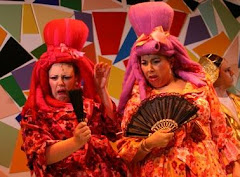
If you’re looking for a cocktail of reggae and ghetto action you might want to check out Theatre Royal’s most popular play, The Harder They Come, based on the 1972 Jamaican film.
Produced in East London, the production has now moved to the Barbican Theatre and has impressed folk there.
It tells the story of Ivan, a country boy who leaves the Jamaican countryside to seek fame and fortune in Kingston through his music, but the harsh reality of the music scene drives him into a fast and furious life as an outlaw.
The show features many returning cast members from the Theatre Royal Stratford East production, such as Rolan Bell as Ivan and Joanna Francis as Elsa.
Monday, 31 March 2008
Stratford theatre piece wows Barbican audience

Monday, 24 March 2008
Does peace stand a chance in Hackney?

This weekend residents in Hackney held a Palm Sunday Ecumenical march, commemorating Jesus’s entrance into Jerusalem.
They prayed along the streets as they marched.
Leading the march alongside church clergy was Councillor Faizullah Khan, who said: ‘As a borough, we have achieved peace and harmony through tolerance and understanding, and we can all help to develop and expand this.’
This is a borough with one of the highest number of gangs in London and serious crime figures.
Even the Home Secretary Jacqui Smith has admitted she wouldn’t feel safe walking alone in Hackney.
We remember victims like Stevens Nyembo-Ya-Muteba, a father who was killed by teeangers in his block of flats for asking them to keep the noise down.
This same weekend of this march, a store manager
Jamie Simpson was knifed to death by three youths while cashing up.
But Cllr Khan still finds this a peaceful and harmounous place to live.
Is it that he is not aware of the bloodier side of the borough or that the march simply wasn’t the place or time to raise such gruesome issues?
Neither is likely to be true.
Regardless of that, the 150 local people and the various leaders who walked and prayed in the streets are proof that locals believe that peace can still be achieved.
They have not given up that hope.
Monday, 18 February 2008
Talking CCTV cameras to scare away yobs
Residents in Barking and Dagenham may feel safer now that the local Council has installed talking CCTV cameras in the borough.
The cameras have audio cards and loudspeakers which are activated by officers in the Council’s CCTV control room.
From there the officers watch what’s going on in the area and can speak directly to people they feel are acting irresponsibly and also ask them to stop doing something.
But just how effective will the cameras be?
On the one hand the talking cameras may be compared to the Trasnport for London’s polite posters you find at the station asking you to be considerate and not play music too loudly. All words, no action really.
Or imagine if a thief is snatching a woman’s handbag: does he suddenly drop it and flee when the controllers voice booms ‘Now, please drop that bag immediately young man!’
But on the other hand, the cameras may make a difference. Known yobs up to know good may be reminded by the booming voice that they are being watched and scuttle, as opposed to a poster that says ‘Anti-Social behaviour will not be tolerated in this area.’
That’s assuming the voice will indeed have a boom.
Monday, 11 February 2008
Prisoners pay-back scheme: how does a community welcome them back?
Jack Straw has launched plans to offer prisoners the opportunity to do community work rather than serve time in jail.
Part of the “alternatives to custody” project includes getting them to do unpaid work for the community, electronic monitoring and help with resettlement.
All this is designed to keep them from staying in prison. The government believes they are better off helping ‘pay back’ the community than being kept in cells.
The Tories have slammed these plans, claiming it is a strong indicationt that the government has failed to build enough jails.
They say under the governments End of Custody Licence scheme, one prisoner is released every 17 minutes.
Above is a video of an alleged robbery in East London.
Some questions must be asked: should this young robber be let out of jail early? If he took part in Straw’s ‘community payback’ scheme, would the community he robbed and injured gain from his release? If he were assigned to do community work on your street, would you let him into your premises to, for example, weed the garden?
On the other hand, others like Straw believe that this guy deserves a chance.
So does the Prison Reform Trust which fights for the rights of prisoners.
In an article in the Guardian, the organisation claims many of them should not be in prison in the first place.
Sunday, 3 February 2008
Examining self-harm in the Asian community

A DVD has been launched to help young people struggling with self-harm.
Why is this relevant to us and just how serious is the situation?
According to the BBC, research shows that young South-Asian women between the ages of 15 and 35 are twice as vulnerable to suicide and self-harm as non-Asian women.
Statistics show that East London has one of the biggest Asian communities in the country. Newham has the second highest proportion of Asian population in England and Wales, with the second largest proportion of Bangladeshis in England and Wales (Tower Hamlets leads in both these statistics).
Additionally, a study of young Asian women in east London by the Newham Asian Women’s Project last year revealed that domestic violence and a pressure to be the ‘perfect student’ or ‘perfect daughter’ were among the reasons for self-harm.
Is it that belonging to these communities is more stressful than others or is it
that there is less help available to them?
NAWP says young Asian women have consistently requested help on the issue of self-harm.
Professionals who work closely with them have also stated the need for better tools to use when discussing the issue, and hence the launch of the DVD.
NAWP launched the DVD, called Everybody Hurts, to address issues like why people self-harm and the support available.
NAWP also has a project called Zindaagi which is dedicated to helping Asian women in East London who are self-harming.
Certain customs in the Asian community have been known to cause the young women distress too.
A study by the mental health charity Mind says that many of the Asian women who attempt suicide do it because of cultural reasons, for example, where the young woman is apparently in disagreement with her parents’ or husband’s traditional or religious expectations.
A small organisation like NAWP may not have the capacity to address these traditions, but by launching the DVD it may be able to patch up the after-effects.
Monday, 28 January 2008
Child slaves raid and the perception of Eastern Europeans
Last week the Met Police carried out pre-dawn raids in Slough where they rescued children from a Romanian trafficking gang.
These children were trained to steal and beg.
Recently, police conducted several raids on homes in East London.
According to the Times, they burst into a small terraced house in Ilford (Redbridge) and found 27 Romanian Gypsies, 16 of whom were children, some as young as 4 months, from several families, sleeping in the bedrooms, lounge and even the kitchen.
No doubt, many issues will emerge from this raid: how big is the actual scale of the trafficking? Is it happening next door to me? Will these children ever be re-united with their families – do they want to be? etc.
It’s also possible that people in East London, like other parts the country, may stereotype Romanians and other Eastern Europeans as smugglers, thieves and beggars.
The Romanian Cultural Institute says that they are perceived negatively – think orphaned-children, stray dogs and too-eager migrants – and less for their arts & heritage highlights.
There are many Romanians and Eastern Europeans living in East London.
Most of them work hard and live peacefully; they should not be painted with the same brush as their countrymen involved in the Slough raid.
What will it take to change society’s negative perception of Romanians?
Tuesday, 22 January 2008
Local leaders map out Olympics legacy

Plans have been drawn up to make sure that we don't lose out after the 2012 Olympics Games.
We know millions - and the figure is growing taller - will be put into the Games.
Leaders from the five London host boroughs of Greenwich, Hackney, Newham, Tower Hamlets and Waltham Forest have asked the government for a firm financial commitment to ensure that the Olympic Park venues (pictured) are viable after the Games.
They also asked for funding to meet the extra demands that the Games will put on council services.
Already some of these boroughs are battling to provide basic council services and it’s easy to see why it baffles councillors as to how they’ll cope during and after the games.
They presented their concerns to the Government Select Committee on
preparations for the Olympic and Paralympic Games in 2012 last week.
The host group say they are pushing for local people to have a say in the long term future of the London 2012 Games.
And talking of what people are saying about the Games, the
London Paper says there’s controversy over plans to remove eight statues (including one of Sir Winston Churchill) to create a pedestrianised piazza in time for the Olympics.
Apparently the plans by Swiss designers, Vogt Landscape Architects, have not gone well with English Heritage, which insists that the statues must not be moved.
Subscribe to:
Posts (Atom)